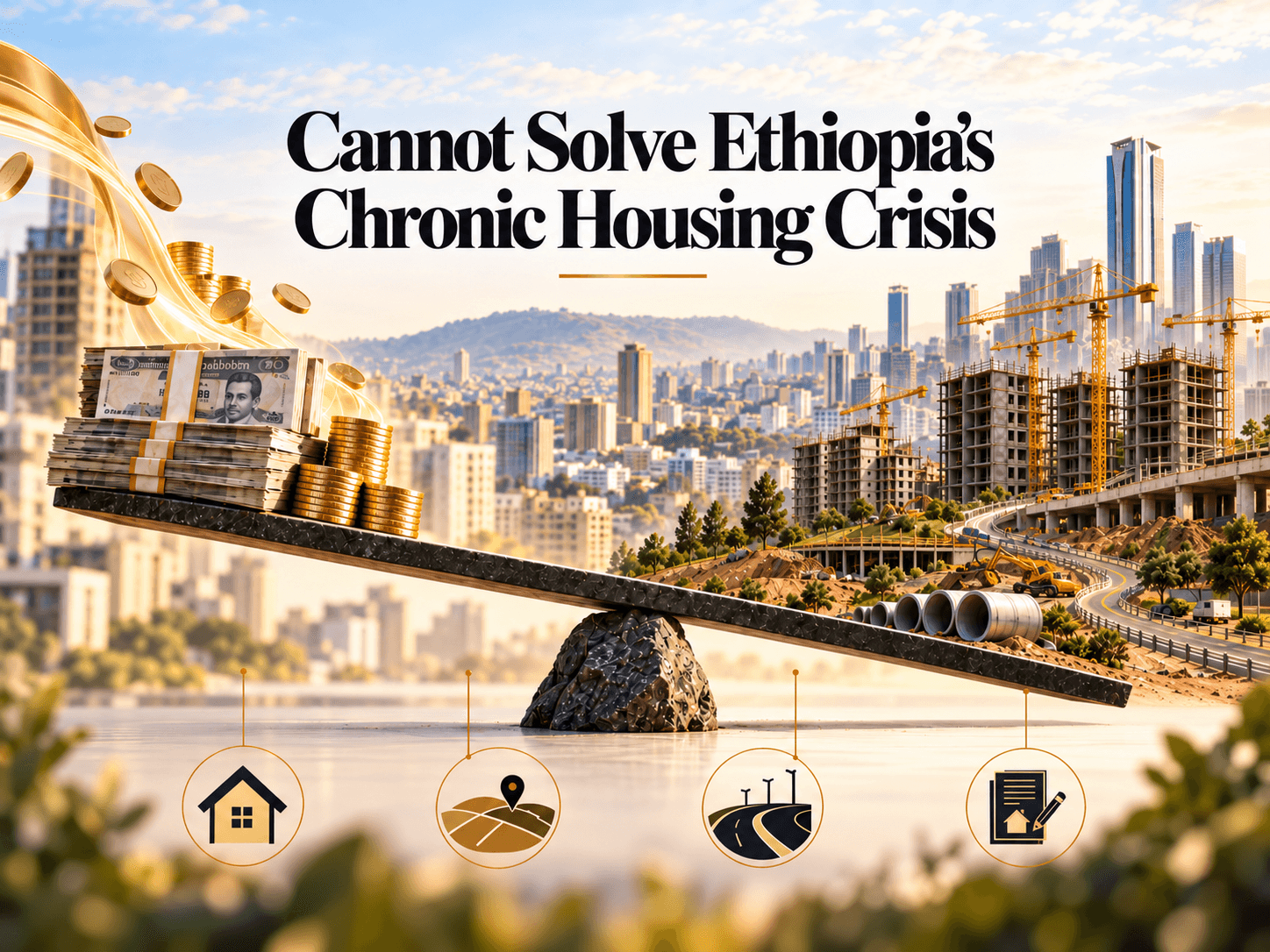
This week marked what the government claims is a monumental financial milestone in Ethiopia’s ongoing effort to modernize its domestic banking landscape and addresses a deepening urban crisis. The signing of a landmark Framework for Cooperation between the National Bank of Ethiopia (NBE) and the International Finance Corporation (IFC) to establish the nation’s first dedicated Mortgage Refinance Company has been touted as a sophisticated shift in housing finance strategy. Capitalized at 100 billion Birr, with a formidable initial contribution of at least USD 200 million from the IFC, this wholesale financial institution is designed to provide long-term liquidity to private primary lenders. In theory, this will unlock long-term home mortgages, foster private-sector participation, and enable the government to achieve its ambitious national goal of delivering 1.5 million affordable, dignified homes. However, while capitalizing a mortgage liquidity facility is a necessary financial intervention, it is vital to recognize that pumping billions into its coffers is not in itself a panacea for Ethiopia’s chronic, deeply structural housing deficit.
To view the country’s housing scarcity merely as a problem of capital availability is to misdiagnose a multifaceted systemic disease. For more than two decades, government-led residential programs, most notably the Integrated Housing Development Program (IHDP), have poured vast sums of public capital into urban construction. Yet, despite delivering hundreds of thousands of condominium units, the public model has failed to keep pace with an explosive urban population growth rate exceeding 4 percent annually. Instead of stabilizing urban shelter, the mismatch between housing supply and soaring demand has rendered homeownership an elusive dream for the vast majority of working-class families, contributing to skyrocketing rental costs in primary urban centers.
The failure to close this deficit is not due to a lack of grandiose commitments or capital injections. Rather, it stems from persistent implementation gaps, institutional inertia, and unfulfilled public promises. One need look no further than recent history to see how ambitious real estate declarations routinely falter on the ground. In June 2021, Mayor Adanech Abiebie signed a high-profile agreement with a South African firm to construct 500,000 affordable housing units in Addis Ababa, pledging 100,000 units in the very first year. Years later, that promise has vanished into thin air, joining a long archive of publicized projects that failed to yield any tangible results on the ground. When public-private partnerships collapse into grandstanding, public trust erodes, and the underlying structural deficit worsens.
Why do financial initiatives and private partnerships continually stall? Because liquidity cannot build houses in an environment bound by institutional and market friction. Primary among these bottlenecks is Ethiopia’s rigid, inefficient, and state-monopolized land lease system. Land in Ethiopia is state property, distributed through bureaucratic mechanisms that are notoriously slow, non-transparent, and prone to rent-seeking. Without accessible, transparent, and affordably priced urban land, private developers cannot utilize cheap refinancing capital to build affordable units; instead, elevated land costs force them exclusively into luxury high-rise developments geared toward elite buyers and the diaspora.
Compounding the land dilemma is the prohibitive cost and domestic scarcity of construction materials. Ethiopia’s severe foreign exchange constraints have long crippled the import of essential inputs like rebar, cement components, finishing materials, and machinery. Local manufacturing capacity remains inadequate to offset these shortfalls. When chronic inflation and currency depreciation drive raw material costs to record levels, the cost of decent homes skyrockets beyond the reach of lower- and middle-income buyers. Injecting 100 billion Birr of mortgage liquidity into a market burdened by severe material shortages risks inflating property prices further rather than increasing real housing stock, creating an inflationary loop in real estate.
Furthermore, pervasive corruption, land grabbing, and unethical practices across urban land management boards have distorted municipal development. Speculative traders and corrupt intermediaries routinely corner prime urban land, holding it unproductive while genuine developers are pushed to the margins. Until strict municipal governance, digital land registration, and uncompromising anti-corruption enforcement are implemented, cheap liquidity will simply feed speculative bubbles rather than spurring genuine housing production.
If the NBE-IFC Mortgage Refinance Company is to avoid becoming an isolated financial instrument that serves only high-income borrowers, the government must couple financial reform with comprehensive structural policy overhaul. First, municipal land management should be radically liberalized and streamlined. Accordingly, it is incumbent on cities mtoust establish transparent, auction-based or targeted land-allocation frameworks specifically reserved for affordable housing developers, paired with density bonuses and infrastructure cost-sharing.
At the same time, it is of the essence to build a resilient domestic supply chain for building materials. Policy incentives, tax exemptions, and foreign direct investment must be channeled into local production of alternative, low-cost, and sustainable construction materials to reduce reliance on costly imports.
Equally critical is enforcing the strict regulatory governance in real estate development. The legal rights of homebuyers ought to be safeguarded through escrow regulations and transparent off-plan sales frameworks to prevent fraudulent developers from siphoning off pre-construction deposits without delivering structures.
he establishment of the Mortgage Refinance Company by the NBE and IFC is an unquestionable step forward for Ethiopia’s financial architecture. It provides the long-term liquidity structure that commercial banks desperately require to issue long-term mortgages. But mortgages are merely financial instruments used to acquire physical assets. If the state does not dismantle such structural impediments as land allocation bottlenecks, material supply chain failures, bureaucratic corruption, and broken public project execution no amount of capital will make housing affordable. True urban reform demands that Ethiopia build not just financial channels, but a functional, transparent, and equitable real estate economy from the ground up.